User Configurations
The User Configurations view allows administrators to view and manage configuration values on a per-user basis. Unlike system configurations, these entries hold a separate value for each user, falling back to a shared default when a user has not set one.
Selecting a User
The view requires selecting a user before any data is shown. Use the Configurations User dropdown at the top to choose one. The grid and all filter controls remain disabled until a user is selected.
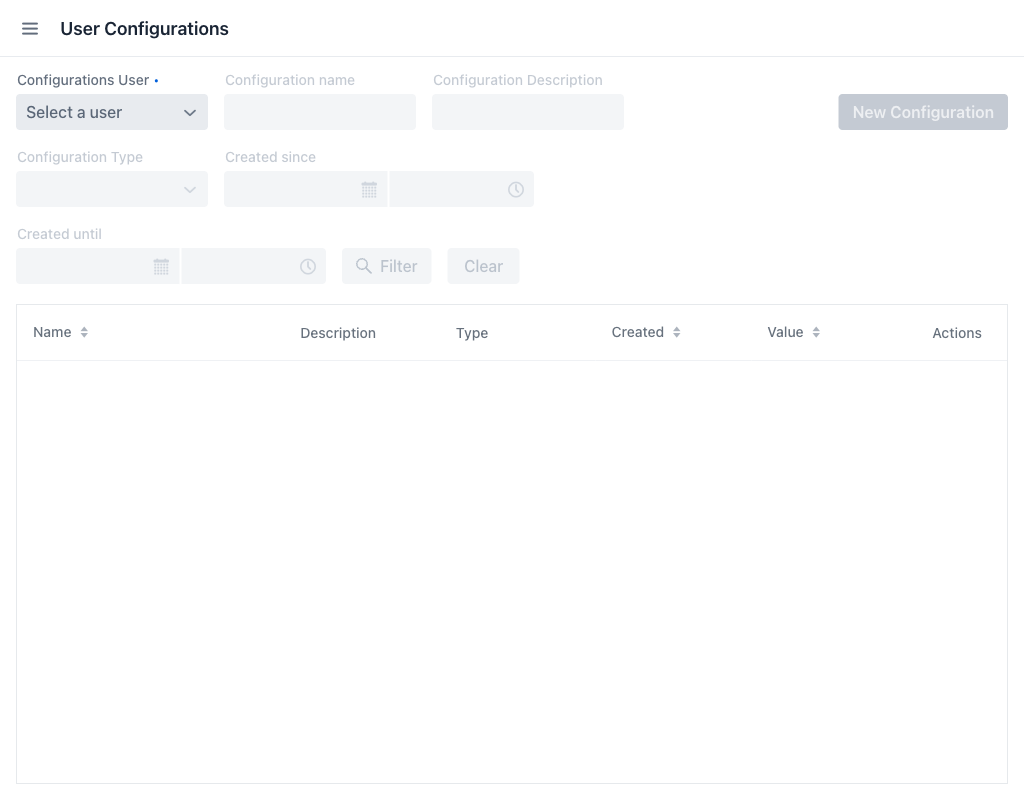
Once a user is selected, the grid loads that user's configuration entries and all controls become active.
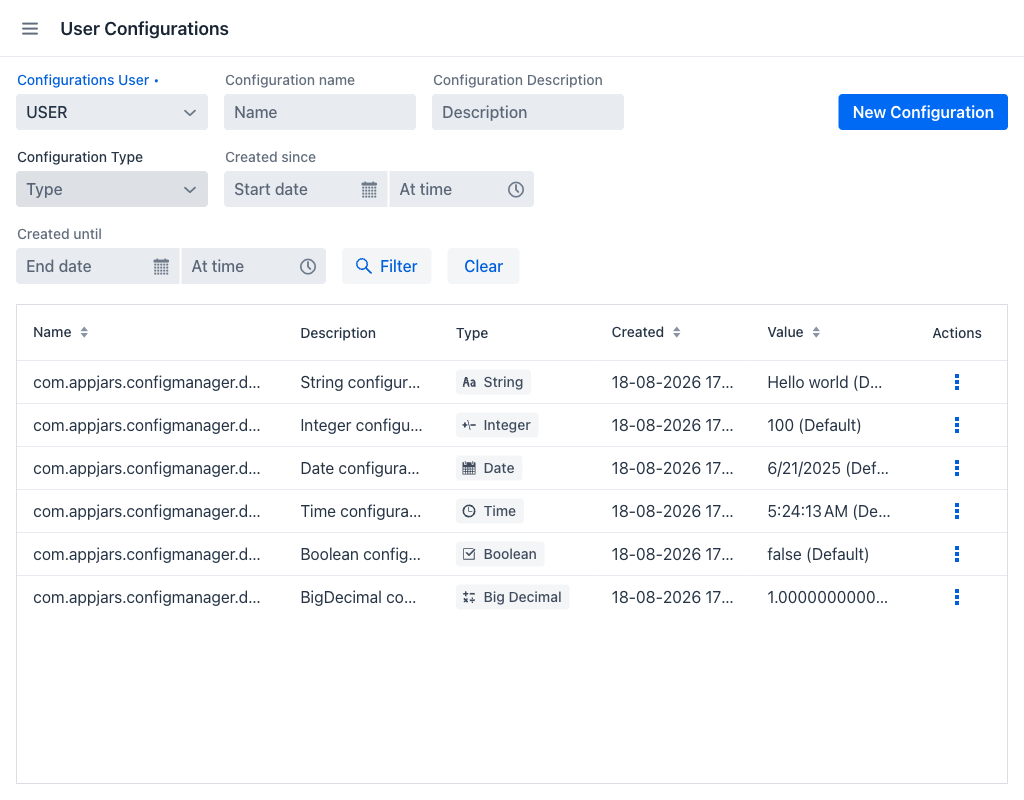
Configurations Grid
The grid shows the selected user's configuration entries with the following columns:
- Name: The configuration key name. Keys are usually written as dotted property names, such as
com.appjars.configmanager.demo.user_string. - Description: A description of the configuration's purpose.
- Type: The data type, shown as a badge: String, Integer, Big Decimal, Boolean, Date or Time.
- Created: The date and time when the entry was originally created, shown in the administrator's own time zone.
- Value: The current value for the selected user. If that user has not set a value, the cell displays the default followed by (Default).
- Actions: A per-row actions menu.
The Name, Created and Value columns can be sorted, and every column can be resized by dragging its edge.
Filters
The following filters are available once a user is selected:
- Configuration name: Filters by key name text.
- Configuration Description: Filters by description text.
- Configuration Type: Dropdown to filter by data type.
- Created since / Created until: Date and time range that narrows results by creation date. Each bound is split into a date field and a time field, and the missing half is filled in automatically: a date without a time starts at the beginning of the day for Created since and runs to the end of the day for Created until, while a time without a date applies to the current day.
The Filter and Clear buttons become active once any filter field has a value. On narrow screens the filter fields collapse behind a Filter button that opens them in a dialog.
Creating a User Configuration
Click the New Configuration button to create a new configuration entry. The creation dialog uses the same fields as the system configuration dialog:
- Name (required): A unique key for the configuration.
- Description: Optional human-readable explanation.
- Value Type (required): The data type. Once the entry is created, this cannot be changed.
- Value (required): The default value for the entry, shared by every user until one of them sets their own. The field appears once a type is selected, and its label names that type:
| Value Type | Input Control |
|---|---|
STRING |
Text field |
INTEGER |
Integer number field |
BIG_DECIMAL |
Decimal number field |
BOOLEAN |
Dropdown showing true and false |
DATE |
Date picker |
TIME |
Time picker |
Row Actions
Click the actions icon on any row to access the available actions. The same actions are also available by right-clicking a row:
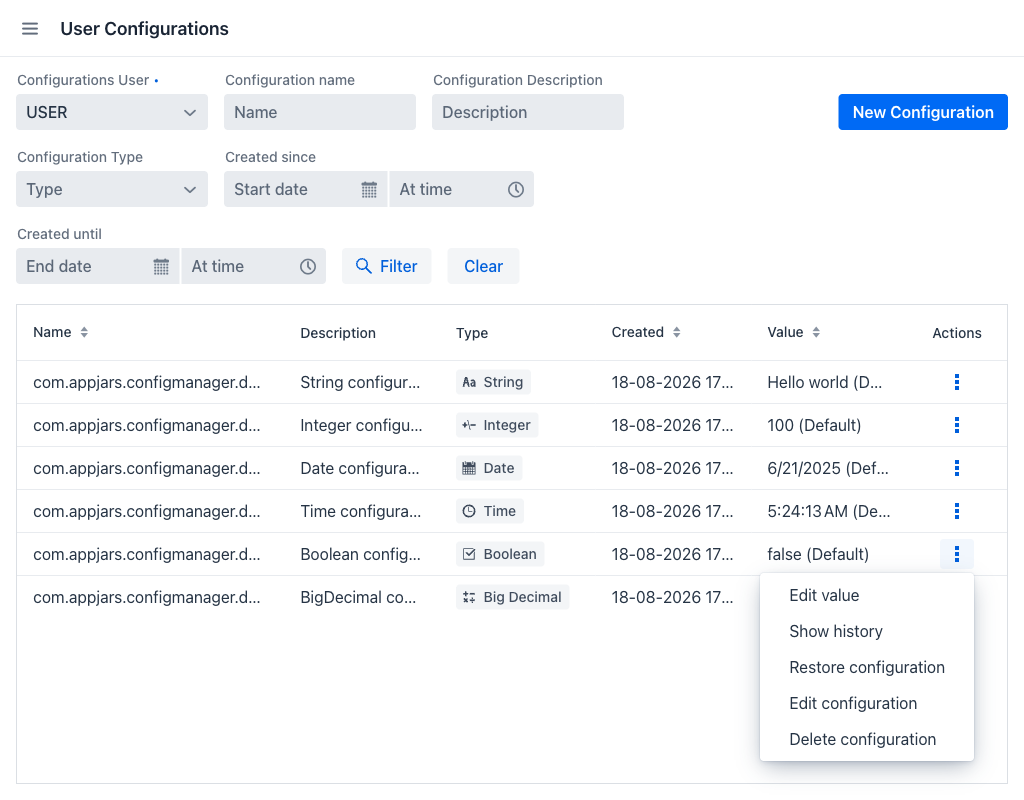
- Edit value: Opens the Edit value dialog to change the value for the selected user.
- Show history: Opens the value history dialog for this entry.
- Restore configuration: Resets the selected user's value to the default, after a confirmation step.
- Edit configuration: Opens the Edit Configuration dialog to change the entry's description or default value. Name and Value Type are read-only.
- Delete configuration: Removes the configuration entry, after a confirmation step.
Warning
Deleting a configuration removes it for every user, together with the complete value history of each one.
Editing a User's Value
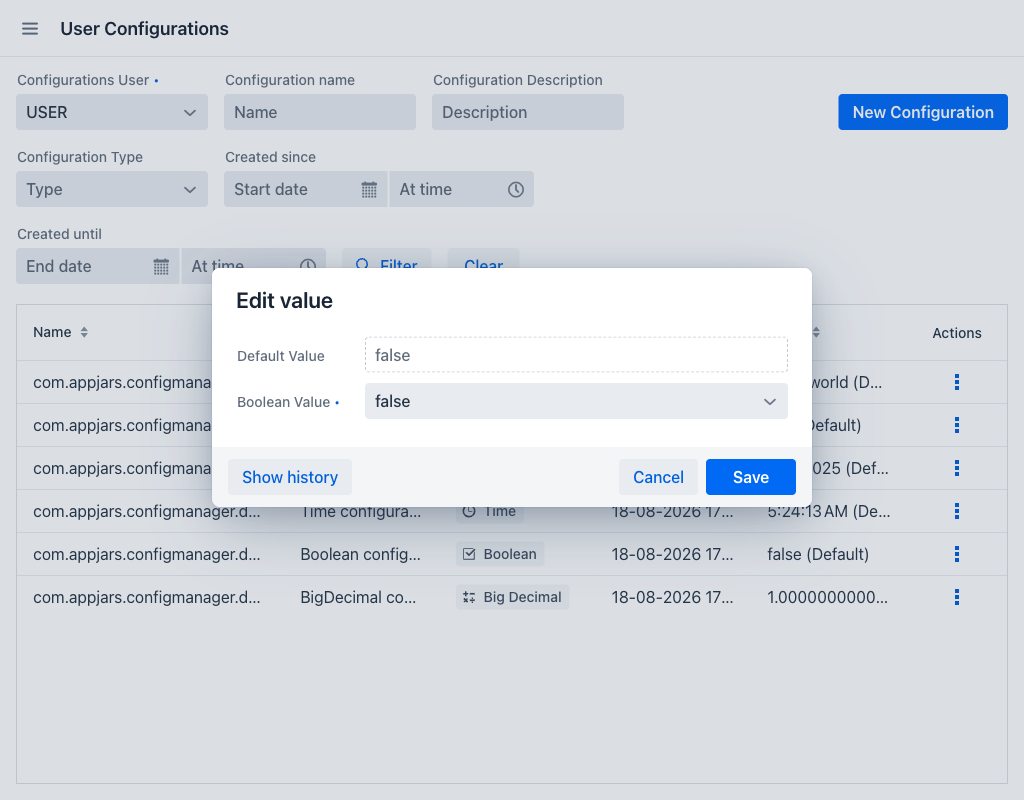
The dialog shows:
- Default Value: The value the entry falls back to when the user has not set one. Read-only.
- Value (required): The value for the selected user. Its label names the data type — the example above shows Boolean Value, rendered as a dropdown — and the control adapts to the type in the same way as in the creation dialog.
The dialog footer provides:
- Show history: Opens the value history for this entry.
- Cancel: Closes the dialog without saving.
- Save: Stores the new value for the selected user. The previous value is kept in that user's history.
The value history of a user configuration includes a User owner column, which identifies the user each recorded value belongs to.
Free Mode
When the application runs without a valid Configuration Manager licence, the view operates in free mode. A bar above the grid carries a Free version badge, whose information icon explains that this version restricts the number of configurations, an Upgrade badge linking to the licensing information, and a Configurations: counter showing how much of the free allowance is in use.
The allowance is five configurations, and it is shared with the System Configurations view: the counter reports system and user configurations together, so a configuration created in either view consumes the same allowance. Entries whose name begins with com.appjars. belong to the AppJars themselves and are not counted.
Once five exist, the New Configuration button is disabled. If more than five exist, which can happen in an application that previously ran with a licence, the Edit value, Show history, Restore configuration and Edit configuration actions are disabled as well, leaving Delete configuration as the only action on each row. Removing configurations until five remain restores the rest of the actions.